Saturday, September 06, 2008

Roosevelt Island Adventure


Ever since our first adventure date when we decided to explore the High Line and to ride the Roosevelt Island tram, we have known the joy of a walk across the island. We have always headed north and enjoyed Trelis (the dinner), the wonderful gardens, and the quiet walk along dorm street (Main St.).


Last weekend we headed out there with some friends and finally went South (before going North and doing the usual things). There's an amazing run down small pox hospital there that's a must see (now before they repair it and take the scariness away). We also discovered a little cat alley with about a dozen little cat houses.


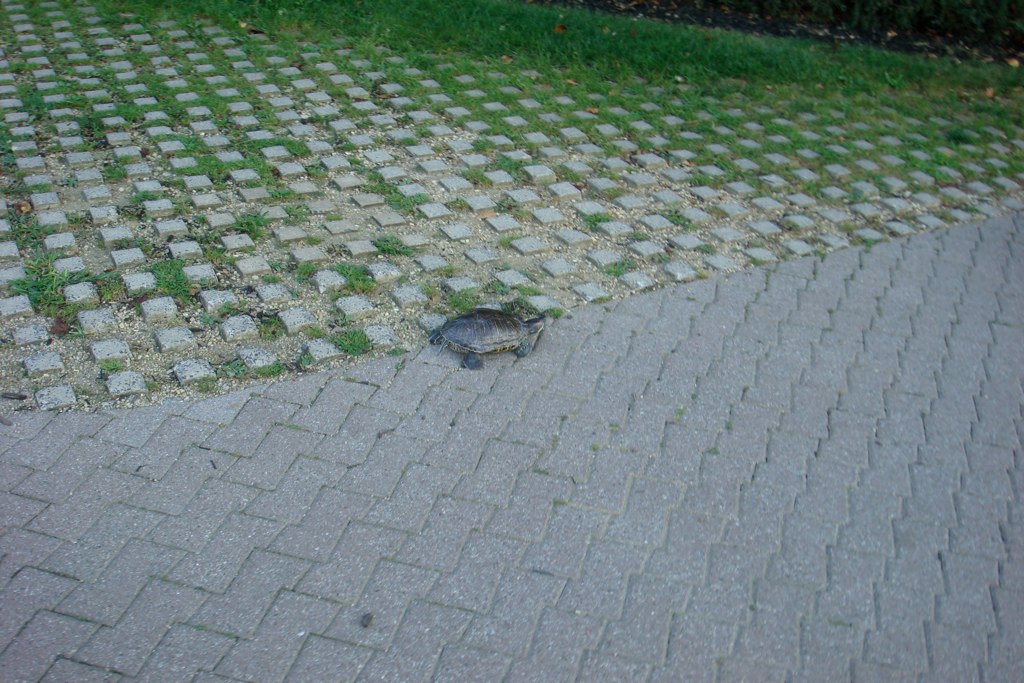
Battery power was low in the camera, so I only took a few pictures:


Wednesday, September 03, 2008

Trains, planes, and automobiles Kansas Trip

We traveled out to Kansas last month for my cousin's wedding. Because crazy airfare prices have finally made it reasonable, we decided to travel by train to Kansas. We booked extra long layovers, so we had a fun time in a couple new cities on the way. While we were there, I rented a car for the first time ever (a little stick-shift Cobalt -- fun, but nothing like my old car). Then we flew back since we didn't have time for the train and when we booked the trip we weren't sure we'd like the train. Anyway, we took some pictures and had a wonderful time seeing family and celebrating the joining of two terrific people.

B

Sunday, August 03, 2008

manatees bumper sticker


Spotted in New Jersey

Carpet Adventure

We've been looking for a new carpet for our place for months now. We saw some beautiful designs on Target.com actually (they online selection dwarfs the store selection), but you could tell from the way some thumbnails didn't match full size images that the colors were not accurate. (As you can see from our pics below, the angle and lightning matters a lot.) So, worried that the online colors were beautiful and the physical colors were scary we decided to venture into the city. 

We went to ABC Carpet and headed straight past the thousands of dollars carpets to downstairs where they have hundreds of dollars carpets pilled with thousands of dollars c
arpets. The operation has a slight feel of a used-car lot, but we met this guy Paul who at first I was skeptical, but he was genuinely a nice guy and we came to really like him. I kept expecting a hard sale for some reason, but he was helpful without being pushy the whole time. After viewing what seemed like every carpet in the place and coming to our first total fashion disagreement (R loved this one carpet that B couldn't stand), we found "the one". Smack in the middle of our price range (marked down from a crazy high price) it was bold, yet also had a traditional feel. 

Thumper seems to approve...


B

Thursday, July 31, 2008

Hoboken Arts - Artifications

I first met Roland Ramos a few years ago when he wandered into a little open mic I co-hosted called Welcome Words. He was able to jam on any instrument and was happy to take the lead or backup anyone in the house. The fact that he's talented was almost outshined by his ability to get the crowd excited and involved. I was always happy to see Roland walk in the door because I knew it would be a good night. Now he's doing something for all of Hoboken that I saw him do for small crowds. Check out his blog to learn more. Also, he put together a video of one of his songs that's worth checking out.

B

Call an audible

After reading about calling and audible I decided to write a letter to amazon.com. Below is the letter I sent to them about "MP3 Downloads".

At the O'Reilly Tools of Change conference this past winter there was an image that was so obvious to everyone that even though there were proponents of DRM in the audience they laughed when they saw it. The first image was of a sidewalk that led in an indirect path to a library with a dirt path worn through the grass of the more direct path that obviously most people walked down. The second image was the same as the first but there was a chain link fence around the grass and dirt path forcing walkers onto the indirect cement path. The chain link fence is DRM. What those images don't drive home is the difference in digital versus physical. In the physical world it would be a rare person who got wire snippers and cut his way through the fence to the other side. In the digital world it is still the rare person who would do that, but with digital snippers can be given to anyone who wants them. Even if there are only a few hackers that can defeat your DRM, they can create software and send it out to everyone on the internet. If you up the ante and make better DRM, you put the legitimate paying customers at risk because now their legitimate activity has been disabled in order to thwart hackers. Hasn't the success of Apple's iTunes store proven that most people want to be honest and will pay for content rather than steal it? If you create DRM that doesn't work as well as the stolen content (which already there are compatibility issues with certain devices), honest people will wonder what they are paying for. Usually pirated content is either equal or less than the original. Don't reach a tipping point by making the legitimate content so difficult to use that the pirated content is better than the legitimate content.

B

Saturday, July 26, 2008

There's a flower in my yumlet


Another R&B adventure day results in a flower in my food. We went out for brunch this morning and I had the Huevos Verde (no ham) and it was as good as it looks. The restaurant does artful plating for all of their dishes, but the carmalized tomato flower... wow!

B

Tuesday, July 15, 2008

B by Steve


Here's a pencil drawing of me by local JC artist Steve Singer. It's from last year. That's exactly what I look like when I'm reading. The drawing was a gift from a friend of ours.

B

Brush & Ink


I've been trying to paint a little recently. I've so far just done some copies of other artists' work, but hopefully I'll ease myself back into my old ways. It's been so long that my confidence isn't high enough to tackle original work, so it's just some reinterpretations for now.

The girl eating toast is from the comic Black Hole published by Kitchen Sink Press. The monkey (upper left) is from a blogger's business card (he said it was from a collection of free images). The sitting woman with her head on her knee is a Schiele from 1918.

The fun thing about posting them is that my camera has face detection software and the little box appeared for the two women, which is a vote of confidence in my art ;)

The monkey didn't get face detection. I'll head to the zoo and see if real monkeys get face detection. Then I'll know if I paint good monkeys.

B

Haunted Cup Cakes

Years ago we were invited to a Halloween party and told to bring a food fitting with the night's theme. We decided to bake cupcakes haunted with the ghost of a KitKat, which meant before we cooked the cupcakes we dropped bits of KitKat bars into some of the cupcakes. They turned out to be a hit, because R is a great baker and because they have a great built in excuse. If you eat a cupcake and there's no KitKat inside, well you just need to eat another one so you can have the unique pleasure of cupcake and KitKat. At the next potluck type party we went to the host was someone who'd been at the Halloween party and she mentioned the cupcakes. We figured we had a hit on our hands. We brought them and did the same thing, although I think we used a different chocolate bar than KitKats, but the same idea. We announced that they were special and some had a hidden treat. Innocent us, we had no idea why some people went crazy over them and stuffed their faces. We didn't really know a lot of people there and had a good time, but hit the road and didn't think too much of our success. However from then on we always brought the cupcakes when asked to bring food. Fast forward a few years to present day and finally a friend of ours let us in on the joke. Apparently when you bring baked goods to some gatherings you shouldn't announce that they are special baked goods with fun inside. Oh well, Hershey works for us. For the Fourth of July we baked some cupcakes for friends and we decided to bake a special cupcake for us -- just devil's food cake, eggs, a little oil, and a Mr Goodbar.

B

Sunday, July 13, 2008

Rethinking the blog

I decided to open the focus for this blog to be ... unfocused. I was segregating all of my thoughts on Judaism into my JBlog, creating mini blogs in iLife, and limiting this one to just career focused topics, but I've decided to just put everything here.

Also my wife and I will be posting, so posts by her will end in her first initial, R, and mine will end in my first initial, B.

B

Saturday, April 05, 2008

Connecting with the artist

As a poet I discovered years ago that open mic poetry readings were wonderful because they connected me to the audience. As you read you are given immediate feedback which is surely daunting for some, but it has helped me greatly. I am always discovering that I have more to learn about how people will react to my writing.

I bring this up because there's great potential to use technology to create this interaction. Publishers could facilitate greater interaction between author and audience. One of the things publishers can offer writers is an advance to cover expenses during the writing process. Maybe another is advance feedback.

Poetry is often short enough that it works in an open mic setup. Novels are far too long, but that's where putting early content on the net makes sense. We need to move away from this idea that the only thing the world sees from publishers is highly polished material. As long as its marked "draft" (in some way), then the more that's out there the better.

Some thoughts from the O'Reilly TOC:

"What's more important, the content or the people?"

"People don't want to change the end of the story, they want to interact with it."

"Storytelling hasn't been changed by technology - just the level of access."

"People are lonely. Create excuses for them to interact. Otherwise you just have traditional marketing."

B

Sunday, March 23, 2008

Launching Digital

Two different music recordings have been in the news. The new Nine Inch Nails (NIN) "Ghosts" project and (with a little less buzz) Melody Gardot. They're both interesting examples of success online, yet I believe their strategies have important differences.

Both have a low price point which is important, but NIN had popularized the album by using pirate music sites and offering exclusives at high price points. Also, I think a key difference is fan base. NIN is electronic music with a fan base interested in electronic media. (One promotional stunt they did was to leave USB drives with content on them in the bathrooms at their shows and the previous album was all tied up in a dystopian electronic surveillance theme.)

I think Gardot has used a much simpler model and grown in a much more impressive way than NIN. It is similar but I think there are important differences. Radiohead is a more similar comparison to NIN since they are both old groups with an established fan base.

An established band has the capital to set up a website and conduct online sales (the NIN interface is impressive). An emerging artist must rely on iTunes. The same is true in the book industry.

Dan Brown, for example, could set up a server, release an eBook and sell print copies via LuLu and give the publishing industry a wake up call. An emerging author would have to use iTunes something that many have not taken advantage of yet (despite Make Magazine presenting the concept at TOC this year). It may just be a matter of time before we see the same thing occur in books that we have seen in music. One could attribute this not happening yet to the slow speed of publishing or maybe it's just something that authors are not interested in. The parallel might hold true that established artists would have to pave the way with independent experiments and then the new comers might move along via iTunes (or some equivalent).

B

Thursday, March 06, 2008

Size Matters

Video conferencing doesn't work. Phone conferences and webex are all second rate to being in the room with one person. Of course when you need to connect 20 people, these technologies help, but the underlying issue is size.

The issue with video conferencing is that even on a large screen TV, the people you are viewing are a percentage of their actual size. There was a fellow we used to video conference with who would be the only one in the room, so he'd zoom the camera in on his face. He joked around that he was doing the anchorman thing, but beyond the humor he was connecting with us better. At that size he was almost life size. You could see hesitation in his gestures or subtle recognition in his face while you spoke. Of course he was disconnected from us because there were a dozen two inch people on his screen.

We are aware of nonverbal communication, yet it seems we don't realize that size matters in nonverbal communication. Sure we have video, but at the normal video conference sizes it is like monotone speech. People are used to communicating with others of roughly the same size. We are probably attuned to the subtlties of nonverbal communication on that scale. While having people larger than life on the screen would be a mistake (it would seem strange to our eyes), we should strive for near life size.

B

Thursday, February 28, 2008

Create it new?

Imagine you have two companies. The first is only a couple years old. It was started by a few established employees with experience and some ambitious and hard working but inexperienced new comers. The second has been around for years is firmly established and has seasoned insiders. What makes the first company a threat to the second? Size, maneuverability, and momentum might be a few advantages of the first company. Consider the second company. If you are making a list, somewhere down the way on it you might mention their legacy data. The fact that they have data going back 10 or 20 years though is that a huge advantage? You might get some great longitudinal studies out of it, but would you actually think of it as a competitive advantage -- especially when weighed against the first company? Would you compare what the systems could do or how much data had in them? Sure apples to apples you would say both matter, but consider that the better system without the data grows.

I have been thinking about system design and legacy data and the weight that is put on maintaining how things used to be. The irony is that often technology is used as leverage to change how things are. Often there is a work flow or politics that is causing inefficiency amongst employees. A new system or technology is proposed because talking to people or reorganizing has resulted only in people returning to old habits. So you use technology to being about change in people. You start there, but then you stop thinking about that and get to the task at hand. Now you are thinking about current system requirements and examining the old system. A requirement of the system will be to import the old data or interface with the old systems. Suddenly what started with "bring about change" is being tempered with "work with the old".

The challenge of working with the old is not there in the first company that we first imagined. That company is free to just bring about change. It can work faster and nimbler because it is paving a new trail and not repaving the old road. Of course things are not that simple. There is a lot of benefit to having an old system to use as a model. Most likely it had things about it that worked well and features you would not have realized are important. Some things need to grow organically and hopefully an existing system has been tweaked to do so. Also there is much benefit in having something familiar to people because in the end it doesn't matter how good your system is if they do not embrace it.

Bearing that in mind though why not have tandem systems? Why not build it new and keep the old? Migrate data from the old system to the new one after you put the new system out there and get it working. Surely you will loose some data that simply doesn't fit the new model, but that's growth. Over the years you hopefully have learned something about streamlining a process down to its essentials. Simple and elegant data is something hard to come by, but hopefully experience is leading you closer to it and not further away.

B

Blogged with Flock

Friday, February 22, 2008

Notes from the Monday keynotes at O'Reilly TOC

Here are my notes on the keynotes from Monday. I kept wondering why the emphasis was on nonfiction and not fiction. I think there's something to be considered in the ease that nonfiction fits into the web and that fiction may not. Is the digital age merely the death of the reference book? Sure the encyclopedia and increasingly the travel guide have major online threats. But what about fiction? Even Fray.com prints now and again...

Stephan Abram

The novel is an invention from the 1800s

Context is king - not content

The half life of a fact is 8 years

Younger audiences scan a website with a circle and then zero in on the middle. No more of the traditional F scan.

Bill Burger

As O'Reilly points out, the threat is not piracy, it's obscurity.

Copying used to be more valuable than the content before the printing press. But Guttenberg and especially the industrial revolution changed the ratio. Now the tools of the web are valued more than the content. [Will we see the same cycle of content vs. tool once again? What happens when the tools are free and ubiquitous?]

Douglas Rushkoff

Contact is king

Mass media connects people to products not people to people

Advertising works best on lone individuals, not well on social groups

Interpersonal media allows the interaction between people

In the online world, there is social currency and real life motivation from your reputation. In the work world you are anonymous in a company with little emphasis to be passionate or to try hard.

Content is a medium. It is an excuse for interacting.

In the first renaissances, hearers became readers
In the second renaissance (the internet), readers became writers

B

Friday, February 15, 2008

Best Practices in Cross Media Publishing - notes

Steve Paxhia gave a presentation at the O'Reilly TOC and I took a few notes.

The Discovery Paradox
- Professionally selected content is not generally findable online
- "Good enough" free alternatives work better


Search Engine Optimization
- Has limited impact
- Gives diminishing returns
- (Phillip Torrone of MakeZine.com said he leaves it to Google to figure out)

Search & Discovery Rights
- Sell your the right to index your site (don't give it away)

Attributor is offering the ability to search for pirates. They take a hash value of your content and then look for that hash value on the net.

Publishing Collaboration
SAP Netweaver Forum has 1 million users (how are you going to sell a book on this subject with this competition?)
Near Time - O'Reilly
Libre Digital MashUps

Consumer Reports entered the digital age by first changing their process and then their technology. (Technology can force people into a new model, but the best bet is to have people change their model willingly and then back it up with the technology.)

Product Plans - 'nuff said

Give readers a choice: paper or digital (paper or plastic?)
Functionality should fit media
New products for new readers

MashUp geographic data - track and predict your clicks

The most important degree for the technology revolution in publishing is... an MLS degree (it's needed for good metadata - think about it, so much of this has organization and categorization as a key value - it is time for the great categorizer Aristotle once again)

B

Wednesday, February 13, 2008

Online Identity as Resume

One of the ideas floating around the O'Reilly TOC was that an online identity is better than a resume. I think this makes some sense. The days of wanting people who would perfectly conform themselves (their lives) to a rote template are passing. When you need creative thinkers and problem solvers, you might find those people best when you give them the space to be themselves. However one thing worries me: resume honesty. I've had the luxury of only really needing a resume once in my life (I worked for myself for a long time and have then been with the same publisher for a long time). I didn't need the job, so I was very frank on the resume. But you hear stories about resume dishonesty all the time. Online identities are surely fraught with inaccuracy or bravado at times, but how much worse so if the online identity is viewed as a resume? But on the other hand maybe we are all best served by knowing our next employer will look us up online. It might gives us pause before clicking "send" and maybe we'll have a little less noise on the net.

B

Tuesday, February 12, 2008

what data when

I spoke with Derek Powazek the founder and CEO of pixish (pixel + publish) about voting before a product is made. It is an essential part of Pixish which would otherwise merely be a call for submission posting board, it is instead something greater. Traditionally you collect data after the fact. You log the point of sale of a product and then mine from that data and related demographics based on a customer rewards card or credit card. But what does it mean to get that data early? People who are motivated to vote on the cover are not only saying which cover they like best, but presumably they are thinking about which cover is the right fit. This means people are engaged with the product in not only the sense of "do I want this or not" but instead they are thinking "what is this" on a deeper level than usual. This might lead to a much deeper connection/identification with a product than you would otherwise have. Not only does voting yield early marketing enthusiasm but also deeper connections to the product.

BTW, speaking of Derek, you should check our Fray (can you believe he got fray.com? He just asked nicely and got it. This guy's got karma.) I just started reading the print edition of Busted and I'm impressed. The commitment to honest but entertaining story telling is paradoxically perfect.

B

eBooks in iTunes

I learned today from Phillip Torrone at the O'Reilly TOC that eBooks are supported by iTunes. I feel silly since I've received PDFs from iTunes when I purchased albums that included them, but I also was told by some in the print publishing world that it just wasn't so. Apparently Make knew about it in 2005 and latter speculated on them being added to the iPod, which I think is the future. EBook readers are only going to be around until phones have comparable abilities (like maybe fold out screens or maybe simple iPhone support). I was convinced of this after hearing on NPR about Kurzweil's phone that reads for the blind (knfbREADER). Vision impaired people said this device they would buy because it meant not carrying around an extra device. Here are people who need such a device and yet they wouldn't buy it unless it was in a phone. I'm sure Kindle will help get things started, but the log that will be lit is going to be a hand held device that handles voice and can be made compact.

B