Monday, May 25, 2009

dishwasher repair - an article for the DIY folks - part 2

Yup, it's all apart again. After replacing the solenoid, I closed the lock, ran the dial around to the different cycles, and saw the solenoid open and close the drain as it should. I didn't have time then for a full cycle so I figured the real test would have to wait.

When I did have a chance, I ran the washer and it burnt out the solenoid again. I was going to closely watch it for its maiden voyage, but the phone rang. When I hung up the phone the scent of burnt electrical doodad was in the air.

I found an appliance repair site that suggested burnt out solenoids twice in a row means the timer is an issue. So back to the old dishwasher in the basement and in a couple minutes I had a new timer installed. Of course now I've burnt out all my solenoids, so I had to order a new one.


The timer assembly


One post I found online suggested that you can save money by just replacing the timer motor in the assembly because it is the problem most of the time. What you should do is test the resistance of the motor and compare it to your schematic. In general, it should be in the 2000 to 3500 ohms range. I had a free full assembly in the basement, so I didn't bother testing the motor. Also I know that the dishwasher in the basement is older but has been run far less than the one in our unit. I would advise you to check how the motor mounts on to the assembly before ordering a new motor. Mine is mounted with little bent metal tabs which are not meant for repeated assembly and disassembly. In my experience it can be tough to get those to hold the motor just right. Also if you fiddle with them too much, they can snap.


The timer motor

It took awhile to match up the numbers from the part online, but eventually I found part 824336 on RepairClinic.com. A search for most of the numbers printed on both the timer and the solenoid had no results in google or on a couple appliance parts sites, so I figured it might be helpful if there was a list posted online of all of the part numbers that are used together in the dishwasher. I tend to prefer confirmation that not only the model number of the appliance agrees, but that the part number does to. You never know if some crazy DIY guy replaced parts in your appliance from a different model in the basement. Anyway without further ado, here's a fascinating list of numbers:


dishwasher

GE
GSD2200G00WW

timer motor
M9Y5Z00271
115VAC CW 3W
RPM 1/3
60 hz
02-39
GH-01

timer gear and switch assembly (from basement)
norm TM061G2
E190094
165D5484P002
H21002123 (stamped on case)

timer gear and switch assembly (from installed unit)
norm TM061G3
E190094
165D5484P003
l21209202 (stamped on case)

drain valve solenoid
E156186
165D5478P002
LR104577-6
120V/60HZ 71WI
STC-13UC B01 (might be 301)

Tuesday, May 19, 2009

dishwasher repair - an article for the DIY folks


Over the weekend I turned the dishwasher on and within only a minute or so there was a light burning smell. It went away just as quickly as it came and I wondered if I imagined it or it was someone cooking next door. I went to the computer and the vague smell of dishwasher soap wafted into the room. I walked into the kitchen to find suds floating across the floor.

My wife and I turned off the dishwasher and quickly cleaned up the mess. There didn't appear to be any damage, but of course I now had a project on my hands. I had recently cleaned out a cabinet and found an old bottle of dishwasher gel that I figured I should use up, so I'd dropped it in the dishwasher that morning. This had me mistakenly thinking it was that the gel had separated and the glob that came out was condensed. After running the washer a couple times and bailing out the interior I reluctantly admitted it was something worse.

I found a good article on repair and common issues that pointed me to the strainer, which might be blocked and not allow draining (it wasn't the motor which I could hear running). We have a simple model with one motor and strainer unlike the one pictured in the article. The top of the strainer was pretty ugly with black gunk, but it was obvious there was no blockage.

Looking under the dishwasher for a place where a block might occur I noticed that there's a solenoid that opens the door to let the water drain out. It seemed rigid but I figured maybe there's some locking mechanism. I spun the dial around through the cycles and the thing never budged (be ready to bail water if you try this at home -- a non-draining dishwasher fills up fast). So I took it apart and it definitely was jammed. It also had that same burnt odor that I'd smelt briefly when I'd turned on the dishwasher earlier.

Luckily our old dishwasher is still in the basement and it's a similar model. So I pulled off the solenoid and was sure I had the problem because this one moved freely. In a couple minutes I had the new solenoid installed. A spin of the cycle button poped the solenoid up and down, so I knew I had a good fix.

Now here's the vaguely interesting part and most of the reason I'm writing the article. The odd thing is that the solenoid that burnt out was stamped 9/15/02 and the solenoid I pulled from the old dishwasher was stamped 9/16/02. Hopefully it lasts more than a day longer than the old one :)


The old burnt solenoid


The good as new solenoid

Thursday, May 07, 2009

Looting Broke Dreams

What I am
is all that I can carry.
-Deborah Digges

All I can dream
is that which I carry.
For a decade I dreamt
of high school hallways
and last night
for the first time
I dreamt of my workplace
and the characters weren't right
they were real people - not parts


Assignment by Group Consensus: Loot my dreams
(unless you prefer the homophone: lute)

Wednesday, May 06, 2009

A Cottage in the Woods

It's been a few years, but I'm finally taking the time to update this.


 We decided to spend Pesach (Passover) in one of our favorite towns (and the first stop from our honeymoon), New Paltz. In looking for a great place to stay we found cottages in a nearby town just a few minutes over the hill (mountain really) from New Paltz.

Clove Cottages B&B is a fun set of little separate cottages on a grounds that contains two lamas (a big selling point for us). The cottages were originally for seasonal workers but later converted to a B&B.


This was our little cottage, number 2. It had a perfect little parking spot for our car, one main room with full kitchen and a back bedroom. A perfect spot for our Pesach retreat.

  We brought along all our Kosher Pesach pots and pans (tupperware) and a bunch of art supplies (wooden box).


 What a wonderful smile to come home to. While we were here I wrote a little short story about a man who was a migrant worker and was living in this little cottage with his wife. The simple life in this cabin had really captured me.

I don't have a photo of it, but we woke up one morning to find one of our windows covered in lady bugs. I captured each one and set it free outside. We heard from the owners that each season they congregate on the one side of the buildings (East I think for the sunrise).


On our adventures in the woods we found a bunch of pull tab beer cans in an old fire pit. Amazing how long "disposable" things last. It's ironic how hard we work to make archival prints yet these labels last so well in the elements with little effort towards longevity


And here's one of the lamas that brought us out to the cottages. They were pretty friendly and we made sure to say hello whenever we were coming and going. The owners were very nice and sociable, but I think we spoke to the lamas more :)

In the evenings we worked on a few art projects.


And of course we had wonderful Pesach meals, like our special breakfast farfel treat...


We went on some bike trips in the state beautiful parks nearby.


To our surprise we found a geo cache on the side of the trail.
We added a not about our adventure to the journal.

We visited Mars and took in some of the interesting fauna ;)


Another one of our tasty Pesach meals. Rachel's avocado,
cream cheese, salsa Tam-Tam treat.


along the rail trail

riding the rail trail
our other lama friend from Clove Cottage


The perfect dessert in New Paltz


coffee bliss
seriously?! a Kosher vending machine at the highway rest stop?

How I've Never Heard Red

Friday is blue some say
and others argue
how mauve is Thursday
but either way it is true
that an artist is eight times more likely
to be a synesthete than me or you
and that makes me wonder
is it in the DNA
a genetic gift from generation to generation
and a barrier to would be artists
who are without oddball notions
but in my strange way of thinking
I wonder, knowing that I'm not normal
will I force things together
or discover unique metaphor
will I be a great poet
or a hack with strange lines
that is to say
am I the right type of odd thinker


Assignment by Mary: Choose a color and write about it.

Friday, May 01, 2009

Take a moment to mitigate the urgent

Ever since I had a history teacher who made us draw maps with lakes, mountains, cities, and boarders form memory, I've know how to tell I was going to learn from something in a way that changed me. My first reaction to those map tests was negative, but I must say -- and I know teenage me would hate this -- I must say I actually look back on those positively. I've always liked maps and diagrams of things, but I've never liked rote memory exercise. Still how else can you know the world without a bit of rote memory? But that's for another time.

I had the same feeling about the maps when I read an article my boss forwarded to me about working on the important things and not the trivial ("mitigate the urgent"). I've always tried to manage my time appropriately and pride myself on working well in environments where I have to personally determine the importance of things. So I read the article thinking it'd be in line with what I've learned, but it had something to teach me -- so I hated it... at first.

My job forces me to frequently evaluate things in terms of the bigger picture. I have a lot of input from different people and need to sort through things on my own. I feel I do well, but after reading the article and paying more attention to myself I was depressed for a few days. I felt I was working on the unimportant and yet felt I was politically forced to do so. I struggled a bit, felt very frustrated, and then the lesson sank in.

In simple terms it is always more appealing to do certain tasks that are familiar and well scoped out. The big lesson I learned was that we bias ourselves towards what we know how to do over the unfamiliar. It sounds obvious, but I know I used to rationalize this away saying to myself that I should do what I knew how to do first because it would go faster and then do the slow and new. But that has nothing at all to do with the overall importance of the task. And its rare that you have a clear case where two tasks are only differentiated by how familiar you are with the solution.

Just taking a moment for a couple weeks to quiz yourself with "is this the most important thing I could be doing" will teach you a lot. Of course there's a certain loss to productivity in doing this, so it's probably something to be reserved for a yearly or so schedule. Asking yourself is this the most important thing I could be doing is actually not the most important thing you must be doing, so balance is key.

It's been a few weeks, but I feel I learned from that article. Oh and I'd like to take a moment and blame the article for why I haven't blogged in so long. I've been mitigating the urgent... yeah... that's the ticket...

The Great Bicycle Rebuild part 1

When I transitioned from elementary school to middle school (from 4th to 5th grade) I fell outside the bus limit. Since school was close to a mile away and my first bike was a BMX type that didn't coast, my parents got me a new bike. I fixated on a crazy mountain bike with 32 speeds (I'd had none of course on the BMX). They agreed and for awhile I rode it back and forth to school. This was close to 20 years ago and I still ride that bike. I took it out for a couple summers to a small town in Missouri where all there was to do was ride past corn fields. I put a lot of miles on the bike, but it also sat dormant for long time periods. I didn't own a helmet until I lived in the city and decided the chances of getting hit were up'd a lot more than in the suburbs. I put a little cat eye mirror on it, but otherwise it had remained basically untouched for years.

The bike is a white Raleigh Technium Heat. I got it based on the fact that it had a ton of speeds and at the time a brand new thing: push button shifting. I had tried to manage my Dad's bike with a slider type knob where you just sort of know when it's slid to the indistinct right spot, so the push button was just about all I cared about. It never really worked right. We took it back in a couple times for adjustment and then I just lived with a periodically dropped chain and clicking up and down to make one shift. I got skilled at putting the chain back on and learned to click the button just right (possibly more superstition than anything). After a time I started tinkering with the adjustments and eventually got it working fairly well.


A few years back I rotated the original tires which were knobby off road tires. the knobs were well worn down, but still a good 1/8" which seemed good enough to me. After about 20 years though the rubber had started to rot as you can see in the pictures. At one time the wall of the tire was solid orange-ish rubber, but the reinforcement strands started showing through and bits of dry, hard rubber flaked to the touch. I decided I was ridding on time bombs and started thinking long and hard about what to do next.

I love the look of the new cruisers. If I were ever to buy a motorcycle (I've got the license actually) it'd probably be a Honda Shadow or similar cruiser. I just like the rake on the front and the nice slow flow of the frame. This is something that might get my wallet one day, the Elektra Ghostrider:


But for now my plan is to rebuild the old Raleigh. I dropped by Grove Street Bicycles which has an amazing business going for it. A lot of great stuff packed in a little store. Lots of staff and LOTS of customers, so maybe this is one local business that won't fly by night. They set me up with some Kenda hybrid tires and tubes.

At home, the old tires were so stiff with age that most of my time was spent removing them and the new ones felt as though they just flopped on by comparison (though they were a good fit). I learned that my 26" x 1.50 wheels can take 26" x 1.95 tires quite nicely. I figure the hybrid make a lot more sense now that I'm an old man who stays on the trail more often than not. I'm excited to try them out, but I also noticed as I did the tire replacement how dry the cassette had gotten and how worn the teeth are.

Here's some pics of the new tire:


So I think this is the first of many updates on the modernization of my bike. There's some rust in spots, the cables have stretched considerably over the 20 years, and I think I need a little bit more comfort in the ride than I did when I was half my age. Maybe I'll get frustrated and buy a new bike or maybe I'll do a full restore on the old one. Hopefully the weather will clear this weekend and I'll hit the local trail with the new tires and see how excited I am by the first upgrade.

The saddle is first on the replacement list, but I'm having some trouble with those rusty cables and getting the front derailleur adjusted so that might trump it.

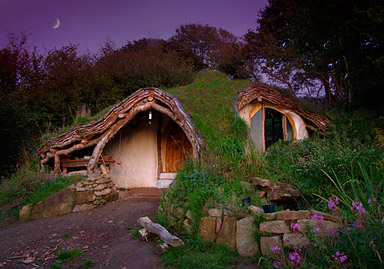
Woodland home dream


A friend posted a link to a Low Impact Woodland Home which caught our imagination. For a long time I've thought that building your own home would make it somehow more of a home, more yours. Maybe it's because of the work I put into my Mustang shaping it into my car with my sweat and busted knuckles. I felt a bit of pride in knowing no one would be happier with the car than I since it was designed just for me in certain ways. So I have a bit of appreciation for what it's like to work on something yourself and make it really yours.

When I first moved to the city I found a place that was actually affordable to me back then because it was really run down. It was a two story, 400 sq foot single unit structure with a 800 sq foot plot. The windows were broken, a chain hung limp around the door and it looked as though people had broken in frequently. It didn't have heat or AC, but I felt maybe I could buy it and swing a few months renting and owning and make the place livable. I day dreamed a lot about it knowing full well I'd never live there. Still the idea that after years of work I could have built a place just as I wanted with my own hands enticed me.

So when I saw the woodland home the old dream came back and my wife and I started day dreaming together. We came up with the plan to make a camp inspired by "Kneller's Happy Camp" (from Wristcutters: A Love Story) and the aforementioned woodland home. Maybe build it out on one of the islands outside Seattle and have art and design classes. There could be multiple buildings all made with the woodland home technique.

The place would be our home completely because it would be made by us and would fit us perfectly. It's just a little dream, but it's ours, made by us with our own hands (err, minds).

Sunday, March 29, 2009

what's with all the old posts on this blog?

Now and then I create posts for this blog and save them as drafts. This morning I finally got around to publishing them and decided to leave the publish dates as the date I composed the draft.

Wednesday, March 25, 2009

People Who Read Don't Know How to Live

I don't think anyone would be surprised to think that literature is sometimes thought of as being a high brow kind of thing. In fact some probably feel that is a great thing. The idea though that all of reading has moved up to that deluxe apartment in the sky known as the ivory tower is surprising. A recent survey in the UK concerning attitudes about reading found that

in many such families, books were seen as alien and unattractive, while reading was considered an anti-social activity for people who, as one respondent said, "don’t know how to live".

By "such families" the survey is referring to people "characterized as lower income, non-professional families".

I found the survey troubling on many levels. I think simply as a humanitarian, the idea that something that is possibly essential to alleviating poverty (education) would be discounted in such a way. And reading can also convey the things about life that make life worth living. Certainly this is not absolute and one can have a deeply meaningful or wealthy life without reading, but the forces of good often rely on reading.

As someone in the world of publishing I of course found the survey worrisome though not as worrisome. I'm not sure the business of books has relied on this group. As the survey points out though paying attention to this resource is important to the book world. It deserves thought as both a growth opportunity and as a potential market trend that could encompass a greater number of people.

I'm curious how bundled internet data (such as a printed book version of a blog or chat logs printed as novels) will affect this. When someone moans about no one reading anymore, someone often points out that more people read more often, it's just that we tend not to count reading on a screen as "reading". And maybe that's the slight of hand that can allow publishers to reach out to the people in the survey. Get the people reading on screen in blogs, chat rooms, VR worlds (E.G., Second Life), or video games and then put that media into a printed book.

Or maybe don't worry about that, but just concentrate on getting the book content into various nontraditional streams. Which brings me back to my humanitarian perspective which says don't worry about print books, just make sure the ideas that inspire, the thoughts that turn minds, the concepts that create positive change, the tools of a better history; just make sure those things are imparted from generation to generation and the world may be healed some day.

Saturday, March 21, 2009

isinglass finings

After a Facebook friend posted about Guinness not being vegetarian, I looked into it.

The issue is isinglass finings which come fish. It is "the purest form of animal gelatin" that is basically used as a filter. So it's not actually an ingredient, but small amounts make it into your beer or wine which is of course important to some vegetarians (like me). According to wikipedia:
Isinglass is a substance obtained from the swimbladders of fish (especially Beluga sturgeon). It is a form of collagen used mainly for the clarification [IE, remove suspended solids and cloudiness] of wine and beer.

My guess is that this is largely a cosmetic thing done to make the beer or wine more palatable. If it wasn't done it'd probably look like mold was floating in it.

What's annoying to vegetarians is that this process isn't necessary, because according to wiki, "left to itself, beer will clear naturally; however, the use of isinglass finings accelerates the process." Some breweries such as my favorite, Magic Hat, uses a centrifuge as a vegetarian alternative. From what I see on the net they began using finings, but tested the centrifuge on the beer Mother Lager and then years ago moved over to using the centrifuge on all their beers.

It seems a centrifuge is a true alternative to isinglass finings, although I saw reference to Irish moss (a red algae), it is not a true alternative.
The process differs, however: isinglass is added at the end of the brewing process, before bottling, whereas Irish moss is added to the hot wort while it is being boiled, and primarily reduces hazes caused by proteins. Since the two fining agents act differently, some beers will make use of both.

I have not found a general rule of thumb for knowing which wine is vegetarian; however, all beer from Germany is safe because of the Reinheitsgebot, a law passed in 1516 which requires beer to be made with only water, barley, and hops.

I'm not clear on whether Kosher wine is vegetarian, but as a general rule of thumb it sounds as though it is not. Isinglass from sturgeon (the "best-quality" isinglass) is not acceptable (some disagree), but "Isinglass also comes from carp, which is Kohser." I didn't find anything definitive, but one or two articles said Kosher wine uses isinglass finings.

If you are interested in Kosher food and vegetarianism, then you should look into a movement within Judaism called Eco-Kashrut. There is some buzz within the movement right now and I'm not convinced it has clearly defined itself, but someday we may have wine that is Eco-Kashrut meaning nothing unnecessarily suffered to create it. Whether that means fish being killed or workers being treated unfairly.

So the bottom line is that as with all foods if you're a strict vegetarian you have to do your research. Here's some helpful lists from wikipedia:

* [A list of vegetarian beers]
* [Beer and cider suitable for the Vegetarian]

Tuesday, March 17, 2009

ColdFusion threads and hung servers

We had an issue today at work with ColdFusion brought to its knees by some unknown processes. The result was the error "java.lang.OutOfMemoryError: unable to create new native thread"

As I often do when googling a CF issue, I wound up on TalkingTree. Through it I found an Adobe post where I learned that you can send a kill -3 to the cfusion process and it will cause a full thread dump in the cfserver.log file.

So it seems we may need to tweak the NewNativeThread [ThreadWaitTimeout (currently 180) and the MaxHandlerThreads (currently 1000)] by determining the root cause of the server slowness. But of course to do that the server needs to get in a slow state again so we can use the fun kill -3.

Sunday, March 15, 2009

Making the private public and the corporate world

Is the same intuition that makes one want to separate public from private tied to what makes good corporate citizens?

When I first joined Facebook some time back it was because there was chatter about it at my workplace (somehow my personal world pushed me into MySpace but not Facebook). As an IT professional I made an account for wholly professional and not personal reasons. I found it humorous to see that most everyone I met from my personal world was on Facebook for exactly the same reason: their job. I felt like I was at a store where everyone was a "secret shopper". Where were the real customers?

This was probably caused by a short lived wave that swept the marketing world a year or two ago when corporations woke up to the social networking world and my connection to Facebook is now more personal than professional. Because of my initial interest, I have been very conscious of the distinctions of professional and personal worlds and how they blur in such communities. Our intuitions of what is public or private are challenged by social networking, while it seems the youth of today is untroubled by having such distinctions.

Some of my thinking on public versus private was solidified recently when I had the pleasure of hearing Fred Wilson speak. What became immediately apparent is that his life is public. Social technology has been good to him and in turn he's good to it by living his life equally in the digital and physical world. He is even willing to have his location available to family and some co-workers at any time from an application on his smart phone.

One of the first slides Fred displayed during his talk was of Napoleon Bonaparte saying, "I can no longer obey; I have tasted command, and I cannot give it up." Fred explained that this was what being in the venture capital world was like and that he knew he was no longer suited to be in a large corporation. He basically framed his advice to the corporation he was speaking to as, "I'm an outsider using these tools in an outside world, so some but not all of it will be useful to you," which was the perfect way to handle the politics of the situation (maybe he's not such an outsider).

What Fred was saying about himself is that he is used to being in control and would not be comfortable with the division of power in the corporate world. The other thing about Fred is that he is completely public with his private world. Check out his blog or twitter posts to get an idea.

So is it possible that the same intuition that makes one want to separate public from private is tied to what makes some people good corporate citizens? In some ways being subordinate is removing your personal feelings from your professional life. I still have to do what my boss asks me to do whether I personally agree or not. In fact most interactions in the corporate world involve compromise and one saves face partly by hiding the extent to which you are compromising. In your personal world you might complain in private about how right you thought you were, but you would hardly be able to work with others if you made your personal world public.

The youth of today seem to largely ignore the public and private distinction. Does this mean they are all Napoleons who will never be good corporate citizens? Will they be able to survive in the work world when the time comes?

But, maybe this is pushing it too far. One could say that business casual dress is making the personal public. When everyone wore suits the only way to be personal was with the tie, but now there's a myriad of acceptable clothes in the workplace which all reveal personal choice in the professional arena. Most people would no longer argue that one can be equally subordinate in a pair of jeans or a pair of dress pants (though the personal choice of one or the other might be telling).

In the end it might be that the inclination to be a good corporate citizen bundles a lot of concepts together. Some of them are essential to being a good corporate citizen (like being agreeable and following orders) and some are seemingly tied, but inessential (like casual dress and posting personal data online).

Recently I have become more public with my private world and feel two conflicting pressures from my professional life. The one is that I work in IT and understanding the social aspect of computing is essential, but the other is that I work at a corporation and negotiating the personal social world in a professional context is dangerous. So in this way, I am testing whether one can remain a good corporate citizen and share my personal world online, but the real test will be when the next generation free of personal private and professional public distinction enters the work place.

Saturday, March 14, 2009

smart parking

From the smart USA Newsletter, vol. 17

Need a place to park in the New York City area? smart USA is excited to announce partnerships with three New York City area parking companies. Meyers Parking, Icon Parking Systems and AviStar Airport Parking now offer smart fortwo owners a 50 percent discount off daily and monthly posted parking rates at hundreds of locations across New York City.

[...]

Interested smart fortwo owners can visit Icon Parking Systems at www.weparknewyork.com to sign-up for this exciting offer. Icon’s Website also features an interactive map of locations, detailed information about their exclusive Price and Space Guarantee, access to discount coupons for Broadway Theatres, Times Square and Madison Square Garden, and an online request form that allows new monthly customers to inquire about seasonal discounts, location-specific availabilities and reduced monthly rates for commuters, storage and other very small/mini cars.

For smart fortwo owners traveling by plane out of the New York City area, AviStar Airport Parking, a wholly owned subsidiary of Parking Company America Airports, LLC (PCAA) is offering half price parking on the daily rate at both JFK and LaGuardia Airports. Customers wishing to take advantage of this special promotion are required to print a special coupon from www.airportcorporateparking.com/smartusa and present it to the cashier at the time of payment. AviStar Airport Parking offers additional services and amenities such as 24-hour shuttles to all terminals, free luggage assistance and free coffee and espresso in their lobbies. The AviStar Airport Parking promotion expires on April 30, 2009.

On Project - the personal story

When I worked on my first intranet application I worked with a lead programmer and a project manager. We would code all day long and maybe once every two or three months we would have a meeting, but usually product specs were communicated in ten minute meetings where the client or project manager dropped by and explained something. These ten minute meetings would rarely be as much as twice a week, so we really did code all day long.

I am now in a position where I'm still working on intranet applications, but I'm deeply entrenched in the corporation and its politics. I love the interactions with people, the brain storming, the give and take of ideas, the multitude of projects, the deeper knowledge of the business process, and the richer experience. There are days though when I have only ten minutes to work on each thing before I am pulled away by something else. The inefficiency of having to pick up things I've dropped off and frustration with distractions has me day dreaming of my former life when I looked forward to the distraction of a meeting instead of the distraction of actually writing code. It's no exaggeration to say that some days now are an inverse of how I used to divide my time between talking about work and doing work. (At heart I'm a DIY guy and although I logically know that talking about a project and developing a spec is work, I never feel like it's work.)

So I spend time thinking about these two different realities:
1. Working 90% on code, but missing out on the world of ideas, social interaction, and the business.
2. Working 10% on code, but feeling that little things get done slowly and big projects get put off for when "there's time for it".

And I love both worlds. I've been happy and satisfied in both, so rather than leave one for the other, I'm interested in having the structure to periodically transition. Most developers I know are stuck more in the second world than the first (I think I may be an extreme case on the days I'm fully in world two). In thinking over all of this I came up with the concept of going on project.

On Project - the concept

What if corporations could offer developers the opportunity to go on project in the same way some go on sabatical? It can be so difficult for internal developers (as opposed to consultants) to free themselves of the beneficial, but distracting corporate world. A unique benefit of full time developers is that they can build a deep business knowledge, but that can come at the cost of being too entrenched in the business with less time to write code.

This works well for the day to day maintenance of an application ("keeping the lights on"), but it slows down new development. When the next big project comes along, try sending the developers on project. Communicate to everyone that these developers should only be contacted in emergencies (the developers probably have intimate knowledge of what they have built that cannot be substituted, so there may be circumstances that necessitate contacting them). This way they will be 100% focused on their current project.

In the same way that soldiers go off to war and the world carries on without them, but reserves their place for their return, these developers would be "on project" until they were ready to come home. At that time they would support the new project and live once again in the corporate world resuming their myriad responsibilities and communications.

An unfortunate circumstance of the current economic times means many corporations have empty desks, so it may even be feasible to assign them to desks in an unoccupied area. This would help everyone involved to respect the on project status of the developers and keep communication down to only the emergency messages.

Depending on what seems acceptable and necessary it might be a good idea to not retain the same phone numbers and email addresses for these developers while they are on project. However, Once a culture is developed of respecting the separation of these developers, then such drastic measures would not be necessary.

The time the developers are on project could be limited to a certain number of months or to fulfilling a certain specification. In keeping with the military metaphor, it might be interesting to limit it to time. The requirements of the project would be listed according to importance and the developers would complete as much as possible. Another interesting experiment with time could be to allow developers to set their own hours while on project as long as at the end of the week it totaled at least 40.

In this insulated environment it is likely that passionate developers will be more productive towards the project and also more innovative with technology. It also would offer an environment where the project team could naturally develop as a team. So called extreme programming can be a wonderful thing, but in my experience it cannot be forced and needs to develop naturally. This insulated environment would hopefully be conducive to that.

Overall though the real benefit is in being able to put developers into an environment where they can be 100% focused on a project. As a side benefit it helps test how well applications are self sufficient or reliant on the developers. If developers know they will be periodically going on project, then they have stronger motivation to build software that requires less maintenance.

extreme programing

When I started my first large project in the corporate IT world (a project that had epic scope creep compared to anything else I've worked on), I worked with just one other programmer and a project manager. We actually functioned in a way that was similar to extreme programing, but I think it worked only because it developed naturally. Also as a side note, the situation worked will even when the project manager left and we were on our own.

Possibly a factor in how it worked was that I consciously decided to code in the style of the existing code. I tried to think like the programmer I was working with. With code there's usually multiple right ways to handle something, but often individuals favor one way. I tried to fit in which may have made all of the code easier to comprehend for both of us. I've only read a few articles on Extreme Programing and sometimes they hint at shared style, but I think this is an important part.

Still I ultimately believe that in the corporate landscape this is something you can not just create. You can set up the right kind of environment, but it needs to happen on its own.

Friday, March 13, 2009

I can eat glass but it hurts me.

Turns out there's more hype than reality to claims that unicode is fully supported in the current operating systems. We looked at OSX and Windows 2000 and the support was frustratingly close, but had issues. Looks like some of it has to do with default settings, but there were also some experiments we did that convinced me it's not so simple. We were looking into it because we were nervous when our DBAs mentioned going 100% unicode (might have just been a trial balloon on their part).

I can't blame any software company for not going fully unicode. After working with it for a few days and doing some experiments, I'm convinced of a PERL article by Gudio Flohr that said (my emphasis), "UTF-8 is fast to write but hard to read for applications. It is therefore not the worst for internal string representation but not far from that."

Oh and if you're not familiar with eating glass (and hence the title of this post), it's the string used to test for unicode compatibility, sort of like "lorem ipsum dolor sit amet" as placeholder text. If you ever try to support unicode, you'll understand why it's like trying to eat glass and not have it hurt you.

Thursday, March 05, 2009

The Optimistic Oracle

Every now and then we get the error "ORA-08177: can't serialize access for this transaction" in an application at work. It's usually on small bits of code that are AJAX like (I never write true AJAX and I'm not sure it happens all that often) and could be run frequently by the user by just clicking a button a few times. My assumption is that its an over zealous person double clicking and therefore double running the code that causes the problem. Anyway, I looked up the issue and just thought this was interesting:

You'll get this message whenever you try to update a row that has changed since your transaction began. (Note that Oracle tries to do this purely at the row level, but you may receive an ORA-01877 error even when the row you're interested in modifying hasn't been modified. The ORA-01877 may happen due to some other row(s) being modified on the block that contains your row.)

Oracle Database takes an optimistic approach to serialization: it gambles on the fact that the data your transaction wants to update won't be updated by any other transaction. This is typically the way it happens, and usually the gamble pays off, especially in quick transaction, OLTP-type systems. If no one else updates your data during your transaction, this isolation level, which will generally decrease concurrency in other systems, will provide the same degree of concurrency as it would without SERIALIZABLE transactions. The downside is that you may get the ORA-08177 error if the gamble doesn't pay off. If you think about it, however, it's worth the risk. If you're using SERIALIZABLE transaction, you shouldn't expect to update the same information as other transactions.


http://www.oracle.com/technology/oramag/oracle/05-nov/o65asktom.html
Crawling at Night: A Novel Crawling at Night: A Novel by Nani Power


My review


rating: 4 of 5 stars
This is a very dark book and though I enjoyed it, it was depressing. There are parts that are just simply beautiful though -- especially the ending, which is quite poetic if a bit trite in the framing. I think in the end it is a book about childhood and growing up which I did not realize at first.


View all my reviews.